
Near-term movements of INR will continue to be shaped by the capital flows situation, which in turn will be influenced by developments in Europe.

'Markets could face uncertainty in the short to medium term.' 'It would be prudent to invest in alternative asset classes, especially debt, for about a year.' 'Bank fixed deposits are offering rates as high as 9 per cent per annum and these can be used as a great hedging tool until equity markets stabilise.'

'We are confident that over the next few years the government will strike a fine balance between populist measures and growth, and manage coalition partners well.'

Double Olympic-medallist Manu Bhaker opted for a three-month rest following her exploits at the Paris Games.

After a sharp outperformance in the mid-and small-cap segments in the first half of calendar year 2023 (H1-CY23), analysts are now turning cautious on these two market segments and suggest investors stay selective and look for valuation comfort and earnings visibility before investing. The S&P BSE Midcap index has surged 13.7 per cent in H1-CY23, and the S&P BSE Small-cap index gained 12.7 per cent during this period, data shows. The S&P BSE Sensex, in comparison, has moved up 6.4 per cent.

While a coordinated aggressive monetary easing from the central banks is most likely to offer some respite in the near-term, it is unlikely to improve the sentiments.

Average salary has grown faster than average business income for three of the last five years. This has implications in a country like India. Most people in India are self-employed, with 51.4% of the population falling in that bracket.

'The markets have corrected almost 8-9 per cent from their highs, so one can accumulate quality stocks at reasonable prices.'

What stocks will gain from a normal monsoon?

'In the short term, we may see some disruptions due to Covid, but in the medium-to-long term, we should keep an eye on US inflation and 10-year bond yields.'

'Investors should reduce cash gradually and look for value investing.'
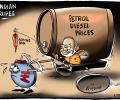
Even as rising crude oil prices, trade war fears and a sliding rupee cast a shadow on market sentiment, Nischal Maheshwari, chief executive officer for institutional equities and advisory at Centrum Broking, tells Puneet Wadhwa that in the next one year, the outcome of the 2019 general election is a bigger challenge for the market.

EM asset classes could rally if the pace of US Federal Reserve rate increases moderates.

So, what does 2016 have in store for the Indian markets? Will they be able to take a giant leap forward in the leap year, and what are the key risks?

Number of stocks trading above 50 times and 100 times earnings are at record highs. When this happened in 2015 and 2016, the Sensex fell 22.6 per cent in a little over a year's time after peaking in January 2015, while it fell by 11.3 per cent in two months from its peak in September 2016.
 © 2026 Rediff.com - Advertise with us - Disclaimer - Privacy Policy - Sitemap - Feedback - About us - Terms of use - Grievances